Worm Gearbox for Sorting Conveyor — Compact, Quiet Drive for Automated Logistics Systems
Modern e-commerce fulfilment centres, postal sorting hubs, and retail distribution facilities rely on complex conveyor networks where hundreds of individual drive units must operate quietly, precisely, and continuously. Lightweight die-cast aluminium alloy worm gear reducers are the preferred choice for sorting conveyor drives: their compact form factor fits within narrow conveyor frame sections, their excellent heat dissipation (aluminium housing) handles the continuous duty cycle, and their low noise level (below 65 dB(A)) is essential in large indoor distribution facilities where worker exposure to machine noise is regulated. View our full product catalogue.
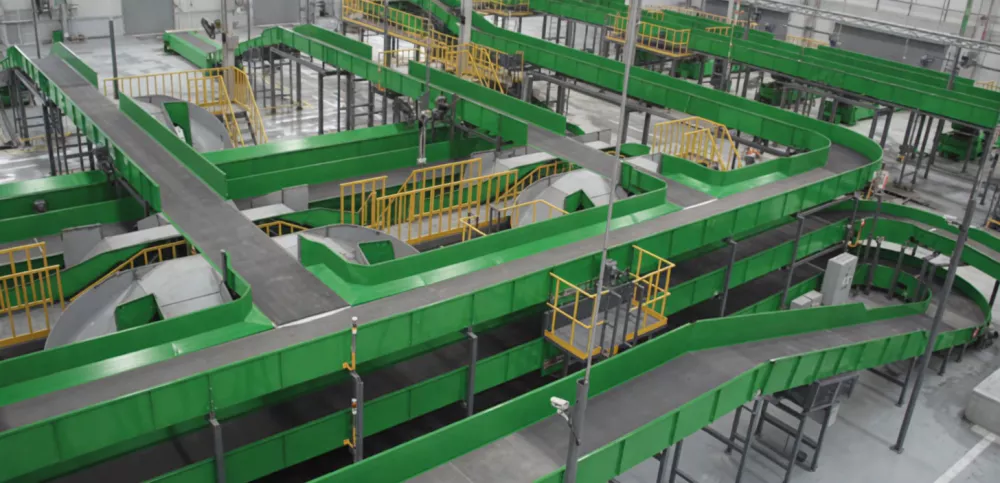
Sorting Conveyor Drive Requirements
Automated sorting conveyors use multiple individual drives — each serving a short conveyor section — controlled by a central WMS (Warehouse Management System) via variable frequency drives (VFDs). Each worm speed reducer must start and stop thousands of times per day, operate reliably in a dusty warehouse environment, and be sufficiently compact to fit in the conveyor frame assembly. The aluminium alloy housing also reduces the overall system weight compared to cast-iron alternatives, which matters for elevated conveyor structures in tall distribution centres.
Key Design Features
- Housing: Precision die-cast LM6 aluminium alloy — 60% lighter than equivalent cast-iron housing; excellent thermal conductivity for heat dissipation in continuous indoor duty.
- Worm Gear Pair: Case-hardened steel worm / phosphor-bronze wheel — low-noise worm mesh, suitable for indoor noise-sensitive environments.
- Noise Level: Below 65 dB(A) at rated load — critical for compliance with Safe Work Australia noise exposure limits in large warehouses.
- VFD Compatibility: Smooth, continuous output torque at all VFD frequencies (5–100 Hz); no resonance issues within the normal operating speed range.
Technical Specifications
| Parameter | Specification |
|---|---|
| Gear Ratio | 7.5:1 – 60:1 |
| Output Torque | Up to 800 Nm (typical for sorting conveyor) |
| Housing Material | Die-cast aluminium alloy LM6 |
| Noise Level | < 65 dB(A) at rated speed |
| Input | IEC B5/B14 flange; solid shaft for belt/chain input |
| VFD Compatible | Yes — full torque from 5 Hz; no derating to 100 Hz |
| Weight | 40 – 70% lighter than cast-iron equivalent |
| Protection Rating | IP55 standard (indoor dusty warehouse) |
| Mounting | Foot-mount; hollow shaft torque-arm; B14 flange |
| Duty Cycle | S1 continuous — rated for 24/7 DC operation |
Compliance & Standards
Sorting conveyor worm gear drives comply with ISO 9001:2015 quality management and carry CE marking. Motor interfaces conform to IEC 60072 B5/B14 flanges — compatible with all standard VFD-rated motor brands used in logistics automation systems. Noise levels are tested to ISO 1680 (test code for acoustics) and certified below 65 dB(A). Housing material conforms to EN 1706 (aluminium casting alloys). For large-volume logistics OEM applications, UL and CSA certifications are available for North American market installations.
Case Studies
E-Commerce Fulfilment Centre — Horsley Park, NSW
Tilt-tray sortation system conveyor drives
Challenge: Noise from 350 conveyor drives in the picking hall exceeded Safe Work Australia 8-hour 85 dB(A) limit, requiring ear protection.
Solution: Replaced cast-iron drives with aluminium worm gearboxes (noise: 63 dB(A)); VFD tuned to smooth ramp-up profile.
Outcome: Noise level reduced to 74 dB(A) (hall average); ear protection requirement removed; picker productivity increased 8%.
Postal Sorting Hub — Tullamarine, VIC
Flat-belt conveyor belt drive units
Challenge: Overheating of cast-iron gearboxes in the ambient 38°C summer warehouse caused thermal protection trips, halting sortation.
Solution: Replaced with aluminium alloy worm gearboxes (30% better heat dissipation); synthetic oil specified for higher ambient.
Outcome: No thermal trips recorded through two summer seasons; sort rate maintained at 100% capacity during heat waves.
Retail DC — Yennora, NSW
Pop-up diverter and conveyor section drives
Challenge: High start-stop frequency (6,000 starts/day per drive) wore out steel input shaft of competitors’ units within 6 months.
Solution: Specified case-hardened B14 flange input shaft; surface hardness 56 HRC; IEC-standard flange for direct motor mount.
Outcome: No input shaft wear failures in 18 months of 6,000-cycle daily operation; 3× service life versus previous drive.
Advantages for Logistics & Automation OEMs
VFD-Ready
Full torque at any VFD frequency from 5 Hz — no current derating or additional motor sizing required.
Low Noise
Below 65 dB(A) rated — designed specifically for noise-sensitive indoor work environments.
Lightweight
Die-cast aluminium housing: 40–60% lighter than cast iron — reduces structure load on elevated conveyors.
Hollow Shaft Option
Torque-arm hollow shaft eliminates coupling and alignment — reduces installation time per drive unit.
Volume OEM Pricing
Production-volume pricing for DC and fulfilment centre rollouts with 100+ units per order.
Frequently Asked Questions
Talk to Our Drive Specialists
Get the right worm gear solution for your application — fast.