Worm Gearbox for Single-Axis Solar Tracker — Durable Drive for Maximum PV Energy Yield
Single-axis solar trackers rotate photovoltaic panel arrays from east to west across the sky each day, increasing annual energy yield by 20–35% compared to fixed-tilt installations. In the Australian solar market — from utility-scale farms in the Pilbara and inland NSW to commercial installations in Queensland — the tracking drive must operate reliably for 25+ years in extreme UV radiation, high ambient temperatures (to 50°C), and occasional severe storms. A heavy anti-corrosion galvanised cast-iron worm gear drive reducer with high-carbon steel worm shaft and UV-stabilised seals is the engineering standard for single-axis tracker drives across the Australian market. See our full solar tracker product range.
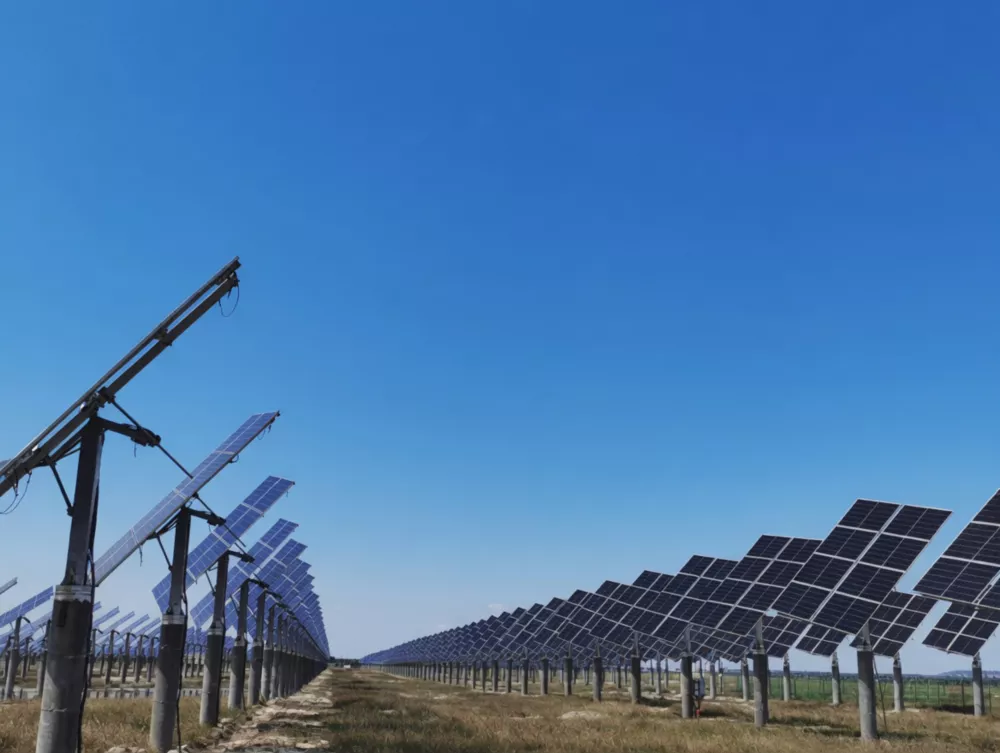
How Single-Axis Trackers Use Worm Gearboxes
In a single-axis solar tracker, the worm gearbox rotates the panel array from approximately −60° (dawn) to +60° (dusk) over the course of each day. The worm gear’s self-locking property is essential: the gearbox holds panels at their commanded angle against wind loads of up to 200 km/h (stow mode) without continuous motor current — minimising tracker control system power consumption and providing fail-safe stow capability if communications with the central controller are lost during a storm event.
Durability Specifications for Australian Conditions
- Housing: Cast iron with hot-dip galvanising (minimum 85 µm zinc) — provides 25–40 year corrosion protection in Category C3/C4 atmospheric exposure at most Australian solar farm locations.
- Worm Shaft: High-carbon steel, induction-hardened to 60 HRC — essential for the 25+ year contact fatigue life required for daily tracker cycles (~10,000 drive cycles over 25 years).
- Seals: UV-resistant Aflas or FKM compound — maintains seal integrity under continuous direct UV irradiance in exposed outdoor installations.
- Lubricant: Synthetic PAO or polyurea grease with NLGI Grade 2 — maintains lubrication film at 50°C gearbox operating temperature in exposed outdoor installations.
Technical Specifications
| Parameter | Value |
|---|---|
| Tracker Application | Utility-scale and commercial single-axis PV trackers |
| Gear Ratio | 40:1 – 100:1 |
| Tracking Speed | 0.25° – 1° per minute |
| Output Torque | Up to 3,000 Nm per drive unit |
| Panel Array Wind Load | Stow torque at 200 km/h: up to 2.5× running torque |
| Housing | Cast iron; hot-dip galvanised ≥ 85 µm zinc |
| Worm Shaft Material | High-carbon alloy steel; HRC 60 min. |
| Operating Temp. | -10°C to +60°C ambient |
| Design Life | 25+ years (100,000+ tracker cycles) |
| Protection Rating | IP65 standard |
Service Factor — Wind Loading: For single-axis trackers in regions with gusts above 150 km/h (cyclone-prone North Queensland, coastal WA), design for stow torque at maximum design wind speed using a service factor of 2.5 over steady-state running torque. The worm gear’s self-locking ensures the array holds stow position through storm gusts without power consumption or active control input.
Standards & Compliance
Solar tracker worm gear drives comply with ISO 9001:2015 and carry CE marking. Corrosion protection (hot-dip galvanising) complies with AS/NZS 4680 and ISO 1461. For Australian utility-scale solar projects requiring compliance with IEC 62817 (solar tracker design qualification), we provide full design documentation. Input motor interfaces comply with IEC 60072 B5. Protection: IP65 standard; IP66 available for tropical/coastal sites.
Case Studies
☀️
Utility Solar Farm — Broken Hill, NSW — 600 kW single-axis tracker array (120 drive units)
Challenge: Original tracker drives (zinc-phosphate coated) showed surface rust within 18 months in semi-arid UV environment.
Solution: Replaced entire fleet with hot-dip galvanised worm gearboxes; UV-stable FKM seals; synthetic grease fill.
Result: Zero corrosion at 4-year inspection; all 120 units performing within original positioning specification.
Commercial Solar — Townsville, QLD — 100-panel single-axis tracking carport
Challenge: Tropical humidity and high UV caused seal degradation; oil weep onto car park surface — site compliance issue.
Solution: Specified Aflas UV-stable seals; grease-filled (no oil weep risk); IP66 housing for tropical rainfall.
Result: No seal degradation or grease escape at 2-year tropical site inspection; compliance issue resolved.
Remote Station — Longreach, QLD — 20 kW farm solar tracker
Challenge: Wind stow failure during dust storm: panels did not stow due to signal loss from central controller.
Solution: Worm gearbox self-locking held panels in last commanded position through the storm; no structural damage resulted.
Result: Zero storm damage after 3 dust-storm events in 2 years; self-locking confirmed as reliable passive stow mechanism.
Our Advantages for Solar Tracker Projects
Hot-Dip Galvanised as Standard
25–40 year corrosion protection without maintenance — standard on all single-axis tracker models.
Passive Wind-Stow
Self-locking holds stow position through cyclones without power or control signals.
100,000-Cycle Rated
High-carbon worm shaft and synthetic grease for 25-year, 100,000-cycle tracker service life.
IEC 62817 Support
Design documentation for solar tracker type-qualification programmes.
50°C Ambient Rating
Synthetic grease and heat-sink housing fins rated for Australian inland solar farm temperatures.
Frequently Asked Questions
Maximise Your Solar Farm Energy Yield
Hot-dip galvanised worm gear tracker drives built for 25-year Australian solar farm service life.