Worm Gearbox for Dual-Axis Solar Tracker — Precision Two-Degree-of-Freedom Solar Tracking
Dual-axis solar trackers achieve the highest possible solar energy yield — up to 40% more annual generation than fixed-tilt panels — by continuously pointing the PV panel precisely at the sun’s position in both azimuth (horizontal rotation) and elevation (altitude angle). Each axis requires an independent worm gear reducer that combines precision positioning (±0.2° accuracy), bidirectional self-locking, sand and dust resistance for outback sites, and a 25-year service life with minimal maintenance. The phosphor-bronze worm wheel and precision-ground worm shaft of our dual-axis tracker drives maintain positioning accuracy and resist the high-cycle partial-rotation wear characteristic of dual-axis tracking duty. Explore all our renewable energy applications.
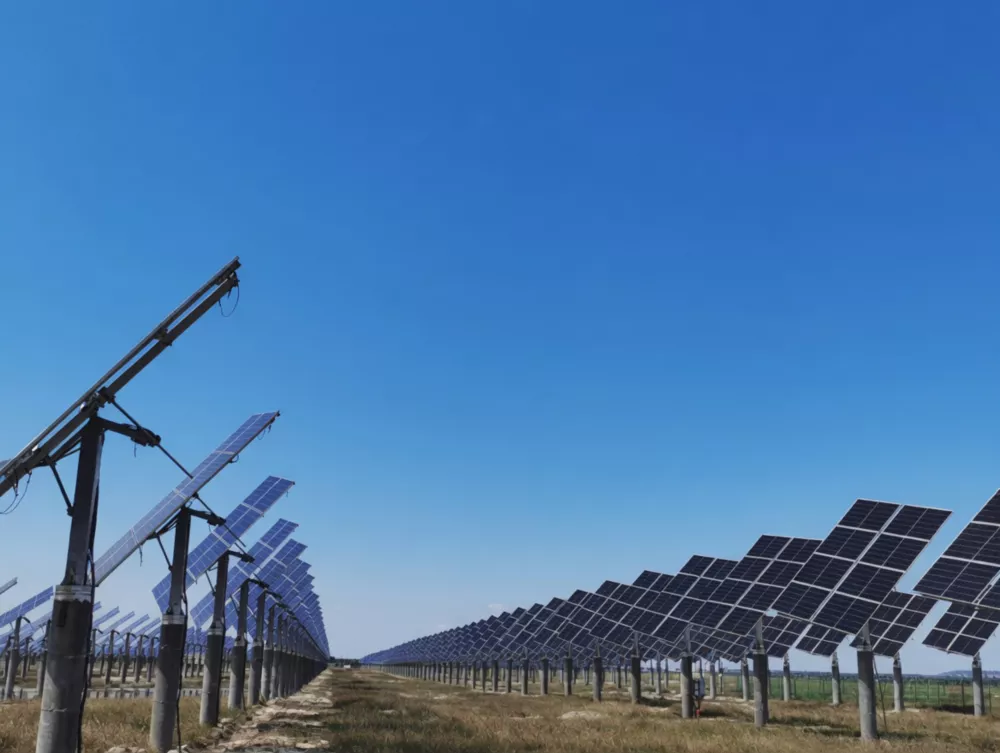
Dual-Axis vs Single-Axis: Drive Differences
Compared to single-axis trackers, dual-axis systems make more frequent and smaller angular adjustments — potentially every few minutes across two independent axes. This higher cycle frequency demands: phosphor-bronze worm wheels (higher fatigue resistance than standard tin-bronze); precision-ground worm shafts to maintain bidirectional backlash below ±0.2°; and sand-exclusion sealing for the outback and desert sites where dual-axis concentrating PV (CPV) systems are most often deployed in Australia.
Material Specifications
- Housing: Cast iron or cast steel; phosphate prime + two-coat corrosion system suitable for C3/C4 atmospheric category at inland solar farm locations.
- Worm Wheel: Phosphor-bronze ZCuSn10P — higher fatigue resistance specifically chosen for high-frequency dual-axis tracking duty.
- Worm Shaft: Precision-ground, 58–62 HRC — ensures ≤ 0.2° bidirectional backlash over 25-year service life.
- Seals: Sand-exclusion labyrinth + primary lip seal — prevents sand ingress in desert and semi-arid outback environments.
Technical Specifications
| Parameter | Azimuth Axis | Elevation Axis |
|---|---|---|
| Gear Ratio | 60:1 – 200:1 | 40:1 – 100:1 |
| Tracking Speed | 0.5° – 2° per minute | 0.2° – 1° per minute |
| Max Travel | ±180° (full azimuth) | 0° to 90° elevation |
| Output Torque | Up to 2,000 Nm | Up to 1,500 Nm |
| Positioning Accuracy | ±0.2° bidirectional | ±0.1° bidirectional |
| Self-Locking | Yes — both axes | Yes — both axes |
| Worm Wheel | Phosphor-bronze ZCuSn10P | Phosphor-bronze ZCuSn10P |
| Protection Rating | IP65 (sand exclusion) | IP65 (sand exclusion) |
Standards & Compliance
Dual-axis solar tracker worm gear drives comply with ISO 9001:2015 and carry CE marking. Worm gear accuracy conforms to DIN 3975/3976 quality grade 5 for precision positioning. Corrosion protection meets ISO 12944 Class C3/C4. For concentrating PV (CPV) and concentrating solar power (CSP) applications, custom DIN quality 4 (±0.05° backlash) worm gear pairs are available. Motor interfaces comply with IEC 60072 B5/B14. Standard: IP65 with sand-exclusion labyrinth.
Case Studies
☀️
Concentrating PV Research Farm — Woomera, SA — Dual-axis tracker azimuth drive
Challenge: Standard tin-bronze worm wheel wore to ±1.5° backlash within 3 years of high-frequency CPV tracking cycles.
Solution: Replaced with phosphor-bronze ZCuSn10P wheel; precision-ground worm; DIN quality 5; synthetic PAO oil.
Result: Backlash maintained at ±0.15° at 3-year inspection; CPV optical concentration efficiency restored to design level.
Remote Solar Station — Coober Pedy, SA — Dual-axis tracker at desert site
Challenge: Windblown red sand penetrated standard IP55 seals; worm mesh abraded by sand particles in gear oil.
Solution: Upgraded to sand-exclusion labyrinth + FKM primary seal; oil analysis programme; quarterly sand purge.
Result: No sand ingress at 18-month inspection; worm mesh wear rate reduced to zero as detected by oil analysis.
University Solar Research — ANU, Canberra — CPV concentrating tracker prototype
Challenge: Positioning accuracy requirement ±0.05° — standard worm gearbox backlash too high to achieve.
Solution: Supplied DIN quality 4 precision worm pair with anti-backlash spring preload; temperature-compensated controller.
Result: ±0.04° positioning accuracy achieved and maintained across −5°C to +45°C ambient temperature range.
Technical Advantages for Dual-Axis Projects
DIN Quality 4 Available
±0.05° backlash for highest-precision concentrating PV applications — available on request.
Sand-Exclusion Sealing
Labyrinth + FKM seal system specifically designed for outback and desert solar farm deployment.
High-Cycle Bronze Wheel
Phosphor-bronze ZCuSn10P — 30–40% higher fatigue resistance than standard tin-bronze.
Thermal Stability
Precision housing geometry minimises thermal expansion effects on backlash across −10°C to +60°C.
CPV Documentation
Full material certs, DIN gear quality certificates, and backlash test reports for CPV qualification.
Frequently Asked Questions
Achieve Maximum Solar Tracking Precision
Dual-axis worm gear drives with phosphor-bronze wheels for 25-year precision solar tracking.